

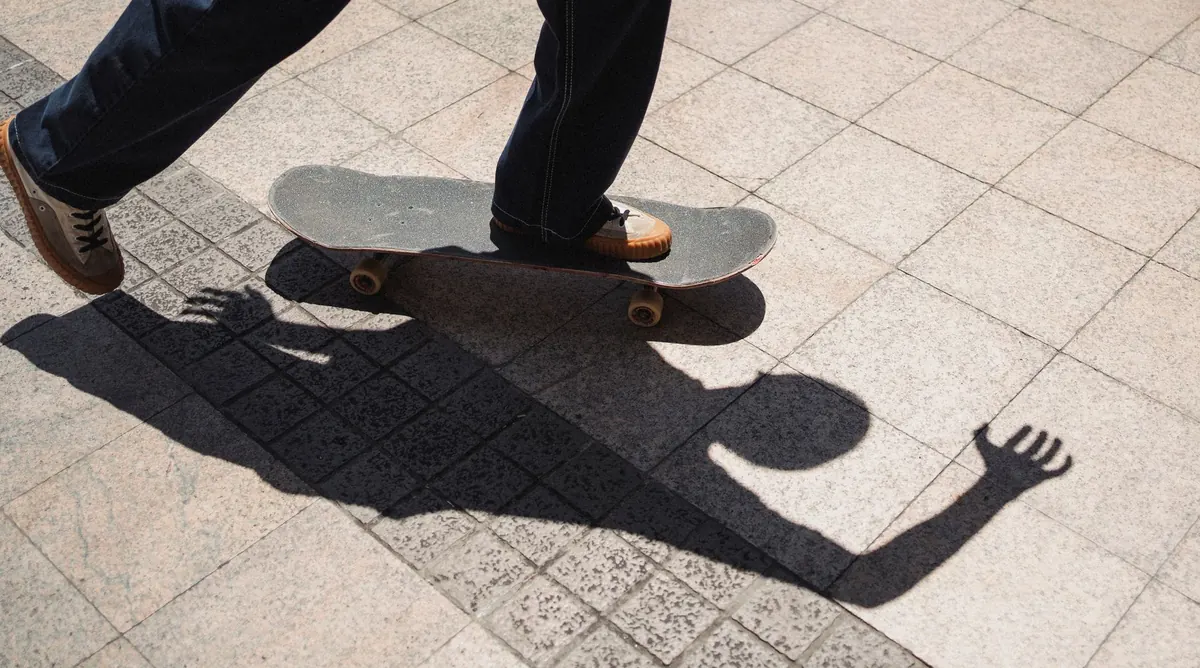
A garden cane pushed into the lawn at nine in the morning throws a shadow many times its own height. By early afternoon the same cane casts a shadow barely half as long. Nothing about the cane has changed; only the angle at which sunlight reaches it has moved. That daily shift turns any flat, sunny patch of ground into a working geometry laboratory, and the mathematics it reveals — angles, ratios and similar triangles — is the mathematics used to measure the height of a tree, a street lamp or a church tower.
Why shadows make such good geometry
Sunlight arrives at the ground in effectively parallel rays, because the sun is enormously far away. When an upright object blocks those rays, the object and its shadow form a right-angled triangle: the object is the vertical side, the shadow is the horizontal side, and the line from the top of the object to the tip of the shadow is the hypotenuse.
Two consequences matter for teaching. The first is that the shape of that triangle depends on one thing only — the angle of the sun above the horizon, which changes steadily through the day. The second is that because the rays are parallel, every upright object in the same place at the same moment produces a triangle of exactly the same shape, just at a different size.
Height of object ÷ length of its shadow is the same number for every upright object at the same place and time.
What you need to take outside
- A straight cane, bamboo stick or metal rod, roughly a metre long. A shorter one works, but keep to the same one all day.
- A tape measure or metre rule, plus a shorter ruler and squared paper for scale drawings.
- Chalk on paving, or pegs and string on grass, to mark each shadow tip.
- A protractor, a pencil and something with a right angle — a set square or a book corner — to check the cane is vertical.
- A watch and a notebook with a simple three-column table: time, shadow length, height of cane.
Choose flat, open ground. Concrete, gravel or paving gives the crispest shadows; long grass blurs the tip and adds error to every reading. Keep well away from walls, fences and trees that might shade the spot during the middle of the day, and try to face south so the cane is in sun from morning until late afternoon.
Running the measurement
- Push the cane firmly into the ground and check with the set square that it stands upright.
- Measure the exposed height above ground and record it. Check it again at lunchtime — a cane nudged sideways by a football ruins the day's data.
- Mark the base of the cane in chalk or with a peg. This is your fixed origin.
- Every half hour, mark the very tip of the shadow, then measure from the origin to that mark. Write down the time and the length.
- Start around 9 a.m. and finish around 4 p.m. If cloud drifts across, wait for a clear moment rather than guessing where the tip would be.
Take the readings in centimetres and keep the method identical each time. A centimetre of sloppiness in placing the chalk mark is normal, and it is worth talking about openly: an error of one centimetre on a 50 cm shadow matters far more than the same error on a three-metre shadow.
Turning shadow lengths into angles
The angle you are really measuring is the angle of elevation of the sun — how high it sits above the horizon. There are two routes to it, and they suit different ages.
Draw the triangle to scale
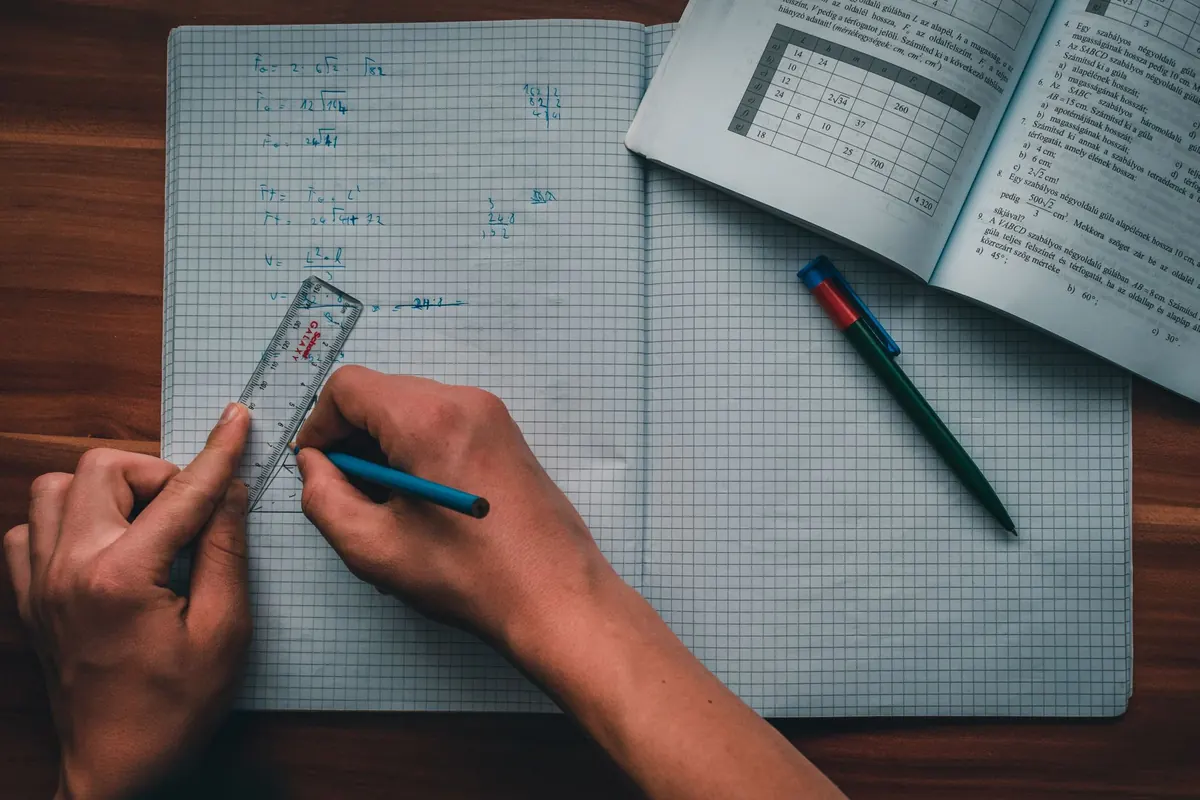
Suppose the cane stands 1 m tall and its shadow is 1.4 m. Draw a horizontal line 14 cm long on squared paper, then a vertical line 10 cm high at one end. Join the top of the vertical line to the far end of the horizontal line and measure the angle at that far end with a protractor. It comes out at roughly 36°. That is the sun's elevation at that moment.
Repeat the drawing for each reading and plot angle against time. The curve is shallow at breakfast and teatime and steepest at midday, which is a satisfying thing to see emerge from your own measurements.
The tangent shortcut
Once tangent has been introduced, the same result comes straight from the numbers: tan of the angle equals height divided by shadow length. With a 1 m cane and a 1.4 m shadow, the ratio is 0.71, which gives an angle of about 36°. The ratio and the angle carry the same information in different clothing, and noticing that is often the moment trigonometry stops feeling arbitrary.
Similar triangles: measuring the tree you cannot climb
At any given moment, height divided by shadow length is a constant for every upright object nearby. So the cane becomes a measuring instrument for anything with a shadow you can reach.
Worked example. At two in the afternoon a cane 1.2 m tall casts a 0.9 m shadow, giving a ratio of 1.33. An oak at the end of the garden casts a shadow measuring 7.5 m along level ground. Its height is 7.5 × 1.33, which is about 10 m. Run it backwards and you have a genuine prediction to test: if the oak really is 10 m, its shadow should be 7.5 m.
Watch for the two classic snags. Sloping ground shortens or lengthens the apparent shadow, so measure along a level line where you can. And measure the tree's shadow at the same moment as the cane's — half an hour's difference is enough to shift the ratio noticeably.
Questions worth chasing
- When was the shadow shortest, and what does that tell you about where the sun was?
- Can you find two times of day when the shadow was the same length? What is the midpoint between them?
- How much does a 15-minute delay change the shadow early in the morning, compared with around midday?
- Use the cane's ratio to estimate the height of a lamp post, a fence panel, a door, a friend.
- Why is the shadow edge soft on a hazy day and sharp on a clear one?
Practical notes before you head out
Take the usual sun precautions: a hat, sunscreen, water, and shade breaks during the hottest part of the day. Never look directly at the sun, and never point binoculars or a telescope at it — every angle in this activity can be found from shadows alone.
Chalk marks wash away in rain, so photograph the marked tips as you go and note the times. On a hazy day, faint shadows still give usable readings if you mark the centre of the blur rather than its edge. If the weather defeats you, a shadow stick on a sunny windowsill with a torch standing in for the sun works surprisingly well indoors.
Then repeat the whole exercise in late September, same cane, same spot. The midday shadows will be markedly longer and the sun's angle correspondingly lower, and comparing the two sets of figures shows that the geometry you measured in July was never really about the cane at all.
Photo: Allan Mas / Pexels